Heat vs. Chemical Bed Bug Treatment in Kingsport, TN
Compare heat vs. chemical bed bug treatment in Kingsport, TN. Learn how each works, key pros and cons, and which may fit your home best.

If you have confirmed bed bugs in your Kingsport home, one of the first decisions you may hear about is heat treatment versus chemical treatment. Which one works better? Is heat worth the additional cost? Will chemical treatment take longer? Does heat kill the eggs? Will pesticides keep working after the technician leaves? The answer is not as simple as saying one method is always better.
Professional thermal heat treatment and conventional pesticide treatment work in very different ways. Heat is designed to raise the temperature throughout the treatment area high enough to kill bed bugs across their life stages, including eggs. Conventional treatment uses professional liquid, dust, and aerosol formulations placed in the areas where bed bugs hide and travel, with residual products continuing to work after the initial visit.
For some infestations, heat makes the most sense. For others, a conventional treatment program is the better fit. And in more difficult cases, the strongest plan may involve a combination of treatment methods.
That is why the first step should be a professional bed bug inspection, not choosing a treatment method before anyone has evaluated the infestation.
Quick Answer: Is Heat or Chemical Treatment Better for Bed Bugs?
Neither treatment is automatically better for every Kingsport home. Heat treatment is generally the faster option. Bed Bugs Undercover raises the treatment area above 122°F and maintains treatment temperatures for several hours, allowing properly delivered heat to target eggs, nymphs, and adult bed bugs throughout the heated area. Conventional treatment works differently. It uses professional liquid, dust, and aerosol products in bed-bug harborage areas and leaves residual activity that continues working after the technician leaves. Bed Bugs Undercover's conventional program includes a minimum of two visits.
If speed is the main concern, heat may have an advantage. If cost and residual protection are important, conventional treatment may make more sense. If the infestation is severe or persistent, a combination approach may be recommended. The right answer depends on where the bed bugs are hiding, how widespread the infestation is, the condition of the property, and what the inspection finds.
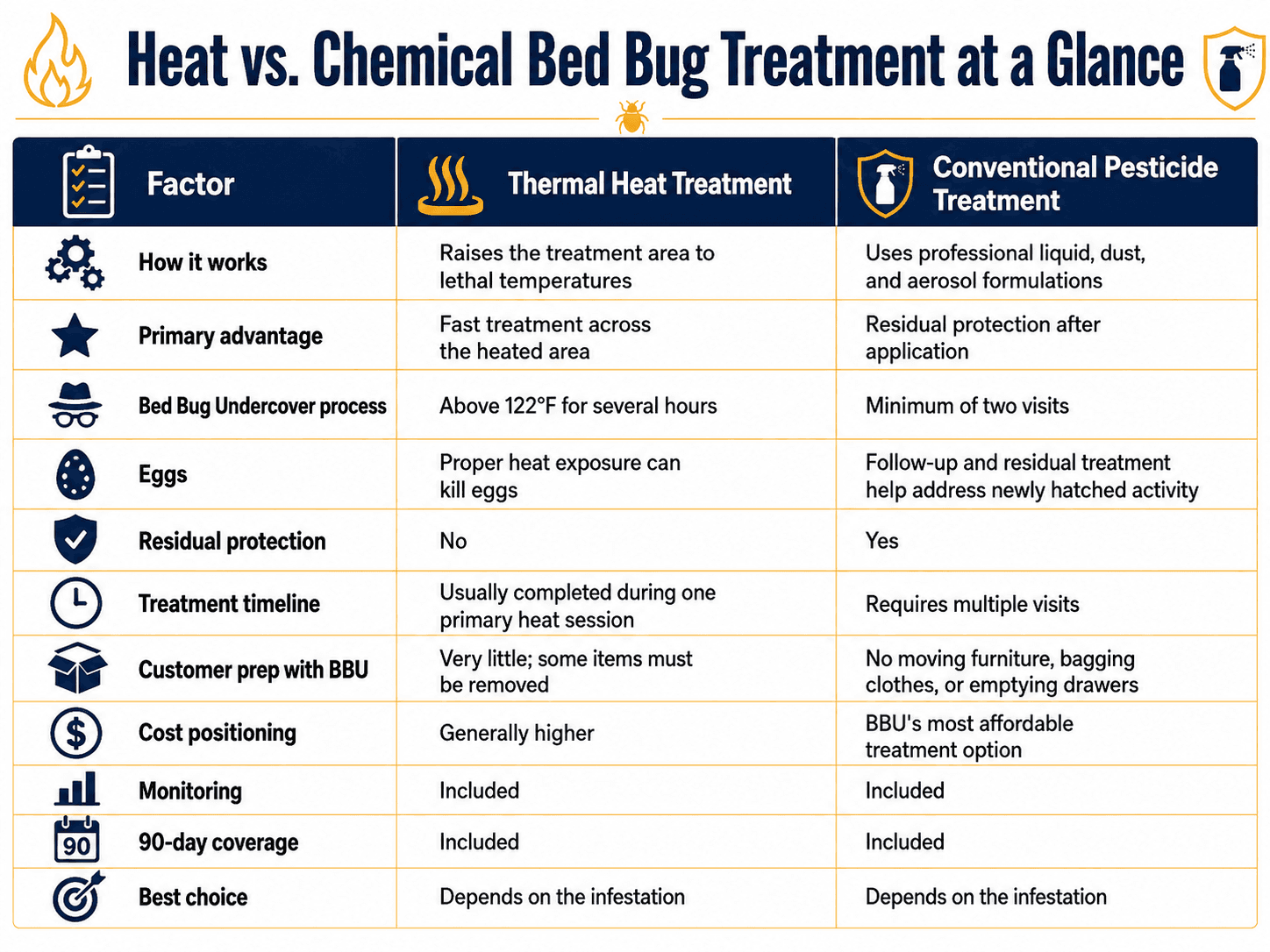
Heat vs. Chemical Bed Bug Treatment at a Glance
Factor | Thermal Heat Treatment | Conventional Pesticide Treatment |
|---|---|---|
How it works | Raises the treatment area to lethal temperatures | Uses professional liquid, dust, and aerosol formulations |
Primary advantage | Fast treatment across the heated area | Residual protection after application |
Bed Bug Undercover process | Above 122°F for several hours | Minimum of two visits |
Eggs | Proper heat exposure can kill eggs | Follow-up and residual treatment help address newly hatched activity |
Residual protection | No | Yes |
Treatment timeline | Usually completed during one primary heat session | Requires multiple visits |
Customer prep with BBU | Very little; some items must be removed | No moving furniture, bagging clothes, or emptying drawers |
Cost positioning | Generally higher | BBU's most affordable treatment option |
Monitoring | Included | Included |
90-day coverage | Included | Included |
Best choice | Depends on the infestation | Depends on the infestation |
Why Bed Bug Treatment Should Start With an Inspection
It is tempting to search online, compare treatment methods, and decide that you want heat or chemical treatment before the technician even arrives. However, that skips the most important part of bed bug control: finding out what is actually happening inside the property. A professional bed bug inspection looks beyond the visible mattress surface.
Bed bugs may hide in places such as:
mattress seams,
box spring folds,
bed frames,
headboards,
furniture joints,
baseboards,
electrical outlets,
wall crevices,
and other protected harborage areas.
The technician also needs to understand whether activity appears limited to one area or has spread into several rooms. It matters because the best treatment for a small, concentrated infestation may not be the best option for widespread activity involving furniture, walls, or multiple rooms. Bed Bugs Undercover's process starts by inspecting the property, determining the extent of the infestation, and explaining the recommended treatment before work begins.
For a Kingsport homeowner, the real decision is therefore not:
“Do I want heat or chemicals?”
It is:
“Based on what you found in my home, which treatment gives us the best plan for eliminating this infestation?”
How Does Bed Bug Heat Treatment Work?
Professional bed bug thermal heat treatment uses specialized heating equipment to raise the temperature throughout the treatment area. Bed Bugs Undercover's current heat-treatment process raises the infested area to above 122°F and holds treatment temperatures for several hours. The goal is not simply to make the room feel hot. The important part is getting lethal heat into the places where bed bugs actually hide. It can include:
mattresses,
box springs,
upholstered furniture,
bed-frame construction,
cracks and crevices,
flooring areas,
and other protected locations within the treatment zone.
Professional heat treatment also requires temperature monitoring. The technician needs to know that the necessary temperatures are reaching the relevant areas rather than relying on the air temperature in one part of the room.
The EPA notes that heat can be used to treat rooms or whole homes and that sufficient temperature and exposure time can kill bed bugs across their life stages, including eggs.
Does Heat Treatment Kill Bed Bug Eggs?
This is one of the biggest reasons homeowners consider heat. Bed bug eggs can complicate treatment because they are more difficult for many control methods to address directly.
Properly delivered heat is different. When the correct temperature reaches the location where eggs are hidden and remains there for the required exposure time, heat can kill the egg stage along with nymphs and adults. That does not mean simply turning up your thermostat, using household space heaters, or trying to heat a room yourself will work.
Professional heat treatment uses industrial equipment and temperature monitoring to heat the treatment area safely and evenly. University of Tennessee guidance specifically recommends that whole-area bed bug heat treatment be performed by trained professionals using industrial equipment capable of monitoring temperatures.
How Long Does Heat Treatment Take?
Bed Bugs Undercover describes its process as holding the infested area above the target treatment temperature for several hours. The exact length of the job can vary depending on factors such as:
the size of the treatment area,
property layout,
furniture,
how quickly different parts of the room reach target temperatures,
the extent of the infestation,
and conditions inside the home.
The company's current process states that customers can generally return home the same evening after heat treatment is completed.
Advantages of Heat Treatment for a Kingsport Home
Heat has several important advantages when the property and infestation are appropriate for it.
1. Heat Works Quickly
The biggest practical advantage is speed. Instead of relying primarily on residual products and repeated treatment visits, heat is designed to produce a major reduction during the heat-treatment session itself.
For a household dealing with a significant infestation and wanting the fastest appropriate treatment option, that can be attractive. Bed Bugs Undercover currently describes thermal heat as its fastest-results treatment option.
2. Heat Can Target Every Bed Bug Life Stage
When lethal temperatures reach the bugs and their hiding places, properly delivered heat can affect:
eggs,
nymphs,
and adult bed bugs.
That egg-killing ability is an important distinction between heat and many pesticide applications. EPA guidance notes that bed bug eggs are resistant to many methods of control and that heat treatment can be used to kill eggs when the required temperature and exposure are reached.
3. Heat Can Reach Bed Bugs Hidden Away From Exposed Surfaces
Bed bugs are not usually sitting in the open waiting for treatment. They squeeze into tight protected spaces. By heating the treatment area, thermal treatment can reach bed bugs inside many areas that would be difficult to contact with a simple surface application. It does not eliminate the need for a trained technician. The treatment still has to be planned, monitored, and delivered correctly.
4. Heat Leaves No Pesticide Residue
Thermal heat itself does not leave pesticide residue behind once the treatment is complete. For some homeowners, that is an important preference.
But there is a trade-off:
No residue also means no ongoing residual protection from the heat itself.
That brings us to one of the biggest limitations.
Limitations of Bed Bug Heat Treatment
Heat can be extremely useful, but an honest comparison also needs to explain what it does not do.
Heat Does Not Leave Residual Protection
Once the property cools down, the heat treatment is finished. There is no continuing thermal barrier waiting for another bed bug that is introduced next week. It matters particularly in situations where there is a continuing possibility of bed bugs being brought back into a property.
Examples can include:
frequent travel,
multi-unit housing,
rental turnover,
recurring visitors,
or other repeated exposure risks.
This is one reason combination bed bug treatment can be valuable in certain cases.
A technician may use heat for rapid elimination and add a residual treatment where appropriate to provide continuing activity after the heat session.
Some Items Need to Be Addressed Before Heating
Bed Bugs Undercover uses a No Prep Protocol, but that does not mean absolutely nothing ever needs to be considered before a heat treatment. For heat jobs, the company provides a checklist covering items that should be removed from the home before temperatures are raised. Customers do not have to:
flip mattresses,
bag all their clothing,
empty every dresser drawer,
or move all the furniture.
But heat-sensitive items still need to be handled according to the technician's instructions.
Heavy Clutter Can Affect Whether Heat Is Appropriate
Bed Bugs Undercover's heat-treatment information specifically notes that heavily cluttered rooms may not be appropriate for thermal treatment. Clutter can interfere with heat distribution and create additional protected spaces. It is another reason an inspection matters before promising a particular method.
Heat Is Generally the Higher-Cost Treatment Path
Bed Bugs Undercover identifies its conventional pesticide program as its most affordable treatment option. It means heat will generally represent the higher-cost treatment path. We are intentionally not giving generic national price estimates here because the price of professional bed bug treatment should reflect the actual property and infestation. If cost is a major factor, ask for the options after inspection rather than assuming heat is necessary.
How Does Conventional Chemical Bed Bug Treatment Work?
The term “chemical treatment” can make the process sound like someone simply walks into a room and sprays the mattress. It is not how Bed Bugs Undercover's conventional bed bug treatment is designed. Also, their conventional program uses several professional formulation types, including:
liquid treatment,
pesticide dust,
and targeted aerosol applications.
Each formulation has a different job.
Liquid Treatment
Liquid formulations are applied to appropriate bed-bug harborage zones and travel areas. They can provide broad coverage while leaving residual activity on treated surfaces according to the product's label and application requirements.
Dust Treatment
Bed bugs can move into areas that are difficult to reach with liquid applications, including structural gaps and protected voids. Professional bed bug dust and aerosol treatment allows the technician to address hiding places such as:
cracks,
wall voids,
areas behind baseboards,
furniture interiors,
and other protected structural spaces.
Dust formulations can remain active longer in dry, protected locations.
Aerosol Treatment
Aerosol formulations are used more precisely in narrow cracks, furniture construction, bed frames, and other areas where controlled application is useful. The important takeaway is that professional conventional treatment is not one spray doing one job. The technician can use liquid, dust, and aerosol formulations together to address different parts of the bed bug's hiding environment.
Advantages of Conventional Bed Bug Treatment
Conventional treatment has several advantages that heat does not.
1. It Is Bed Bugs Undercover's More Affordable Treatment Option
For homeowners whose property and infestation are appropriate for conventional treatment, cost can be one of the biggest benefits. Bed Bugs Undercover specifically positions its conventional program as its most affordable bed bug treatment option. It does not mean it is automatically the cheapest solution in every situation. A severe or complicated infestation may require additional treatment. For many suitable cases, conventional treatment provides a professional option without moving immediately to the cost of thermal heat.
2. Residual Products Keep Working After the Technician Leaves
This is the biggest strategic difference from heat. Heat stops working once the property cools. Residual pesticide treatment continues to work on treated areas for a period after application. It matters because bed bug activity does not always disappear at the exact moment the first treatment ends. Bed Bugs Undercover's conventional program is designed so that bed bugs moving through treated areas between visits can encounter the residual product.
3. It Can Be Targeted to Specific Hiding Areas
A professional inspection may show that the infestation is concentrated around particular rooms, furniture, cracks, or structural areas. Conventional treatment allows the technician to apply different formulations according to those hiding locations. This is where dust and aerosols become particularly useful alongside liquid treatment.
4. Bed Bugs Undercover Handles the Major Preparation
Traditional bed bug treatment preparation can be overwhelming. Bed Bugs Undercover's conventional program uses its No Prep Protocol. Customers are not required to:
move furniture,
bag every item of clothing,
or empty dresser drawers.
The team handles the treatment preparation before application begins. It is a significant practical difference for households that are already stressed by an infestation.
Limitations of Conventional Treatment
Conventional treatment also has trade-offs.
It Requires Multiple Visits
Bed Bugs Undercover includes a minimum of two visits with conventional treatment. Bed bug eggs can survive some pesticide exposures, and activity can emerge after the first visit. Residual products and follow-up treatment are therefore used across the treatment period.
EPA guidance similarly emphasizes that bed bug management often requires a comprehensive strategy rather than expecting one pesticide application to solve every aspect of an infestation.
It Does Not Produce the Same Immediate Whole-Area Effect as Heat
Heat aims to expose the treatment area to lethal temperatures during one treatment session. Conventional treatment relies more on:
direct treatment,
residual activity,
movement of bugs through treated areas,
monitoring,
and follow-up visits.
That means the timeline can feel different. If the homeowner's highest priority is the fastest possible treatment process and the property is suitable, heat may have an advantage.
Professional Product Selection and Placement Matter
Bed bugs hide in extremely small spaces and can be difficult to eliminate with casual applications. The University of Tennessee notes that many bed bug populations have shown resistance to some insecticide classes and recommends professional pest management once bed bugs have been confirmed. It is another reason conventional professional treatment should not be confused with buying a can of spray and treating visible surfaces yourself.
Which Treatment Works Faster: Heat or Chemical?
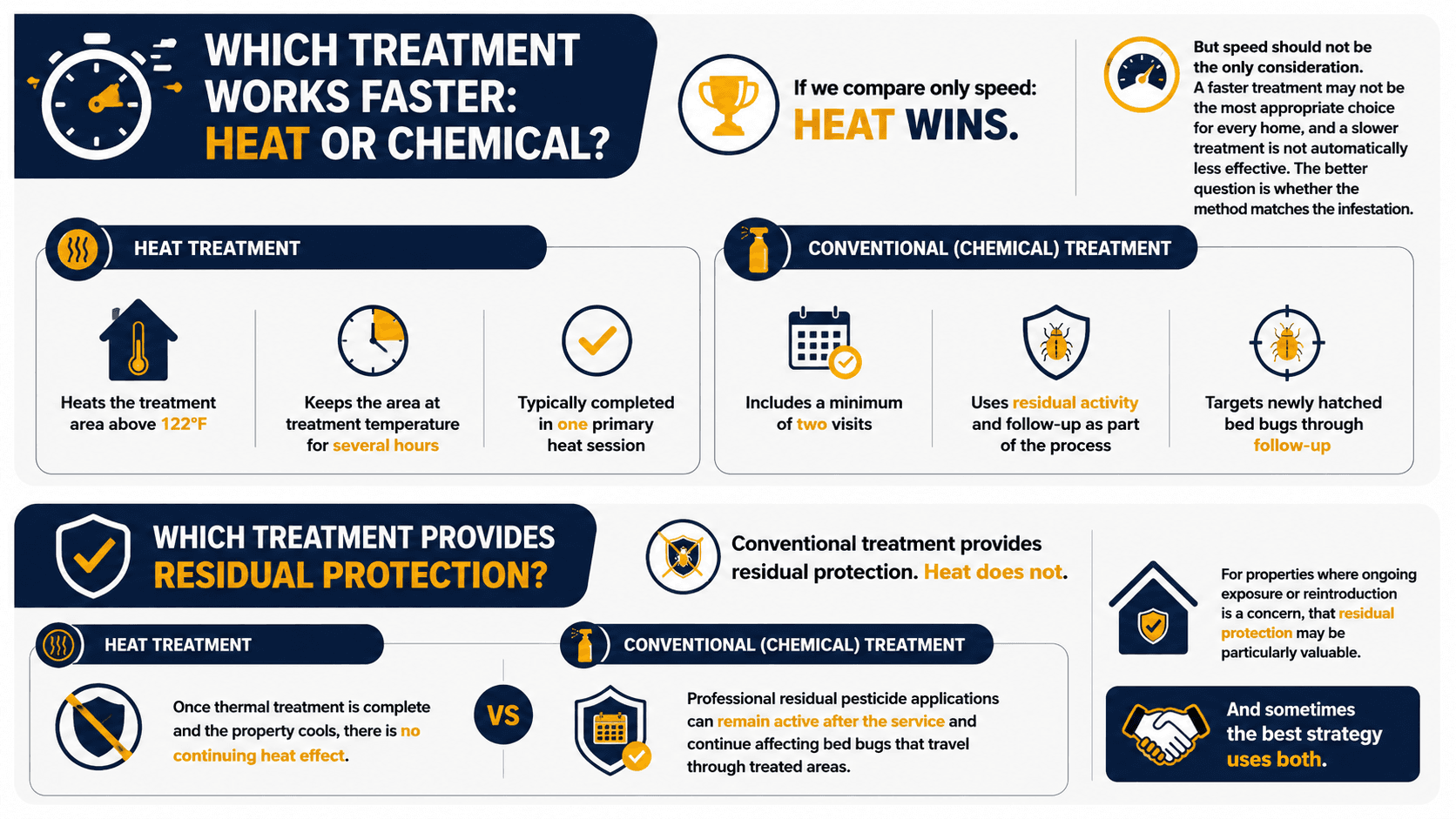
Heat treatment is generally faster. Bed Bugs Undercover heats the treatment area above 122°F and keeps the area at treatment temperature for several hours.
Conventional treatment, by contrast, includes a minimum of two visits because the program uses residual activity and follow-up as part of the elimination process.
If we compare only speed:
Heat wins. But speed should not be the only consideration. A faster treatment may not be the most appropriate choice for every home, and a slower treatment is not automatically less effective. The better question is whether the method matches the infestation.
Which Treatment Provides Residual Protection?
Conventional treatment provides residual protection. Heat does not.
This distinction is important enough to repeat. Once thermal treatment is complete and the property cools, there is no continuing heat effect. Professional residual pesticide applications can remain active after the service and continue affecting bed bugs that travel through treated areas. For properties where ongoing exposure or reintroduction is a concern, that residual protection may be particularly valuable.
Moreover, sometimes the best strategy uses both treatments
Can Heat and Chemical Treatment Be Used Together?
Yes. The decision does not always have to be heat OR conventional treatment. Bed Bugs Undercover offers combination bed bug treatment specifically for situations where using more than one method provides a stronger treatment plan.
One example is:
Heat + conventional pesticide treatment
Heat can provide rapid treatment across the infested area, while a follow-up residual application can continue working after the property cools. Bed Bugs Undercover currently recommends combination approaches particularly for more difficult situations such as:
severe infestations,
persistent infestations,
multi-room activity,
previous treatment failures,
and cases where one method alone is not enough.
This approach is also consistent with University of Tennessee guidance, which notes that thorough bed bug management can involve combining professional pesticide applications with heat and other nonchemical controls.
What About Aprehend?
Heat and conventional pesticides are not the only professional treatment options. Bed Bugs Undercover also offers Aprehend biopesticide treatment. Aprehend uses Beauveria bassiana, a fungal biopesticide applied in targeted bands along areas where bed bugs are likely to travel. When bed bugs cross treated areas, fungal spores can attach to them and be carried back toward harborage areas. This gives the technician another residual treatment option in situations where inspection findings suggest it makes sense. Aprehend may also be incorporated into a combination treatment rather than being treated as an isolated choice. The point is not that every Kingsport homeowner needs Aprehend. The point is that Bed Bugs Undercover has more than one treatment tool available, so the treatment can be selected around the infestation rather than forcing every customer into the same program.
Which Treatment Requires More Preparation?
With Bed Bugs Undercover, neither option requires the kind of major homeowner preparation many people associate with bed bug treatment.
Conventional Treatment
Under the company's No Prep Protocol, customers do not need to:
move furniture,
bag clothing,
empty drawers,
or pack up the home.
The technicians handle the preparation required for treatment.
Heat Treatment
Heat also uses a low-prep approach, but some items need to be removed because of the temperatures involved. The team provides a checklist before treatment.
So the distinction is:
Conventional: no major customer preparation.
Heat: very little customer preparation, with specific heat-sensitive items addressed beforehand.
If you have already started bagging everything in your home, stop and ask what your actual treatment plan requires before creating unnecessary work or moving potentially infested items from one area to another.
Which Treatment Costs Less?
Based on Bed Bugs Undercover's current service structure, conventional pesticide treatment is the more affordable option. Heat treatment requires specialized industrial equipment, temperature monitoring, and several hours of controlled heating. However, price should not be considered in isolation. A treatment that costs less but does not fit the infestation would not be a good value. Likewise, paying more for heat when conventional treatment would have been entirely appropriate may not be necessary.
Bed Bugs Undercover provides an upfront treatment recommendation and quote after inspection so you can understand the treatment plan before deciding whether to proceed.
When Might Heat Treatment Make More Sense?
A professional technician may consider heat when factors such as these are present:
getting the fastest appropriate result is a major priority,
the property can be effectively and safely heated,
the infestation is appropriate for whole-area thermal treatment,
rapid treatment across bed bug life stages is important,
or inspection findings suggest thermal treatment offers an advantage.
Heat can also become part of a broader combination strategy when rapid elimination needs to be paired with residual protection. This is why a generic statement like “heat is always the best bed bug treatment” is too simplistic. A method can be excellent and still not be the right fit for every property.
Learn more about how Bed Bugs Undercover performs professional thermal heat treatment.
When Might Conventional Treatment Make More Sense?
A conventional program may be considered when:
cost is an important factor,
residual activity would be beneficial,
the infestation can be treated effectively with targeted professional applications,
the property is not ideal for thermal treatment,
or a multi-visit treatment plan is appropriate.
The ability to use liquid, dust, and aerosol formulations also gives the technician flexibility to address different hiding environments. For example, if bed bug activity has moved into tight structural spaces, professional dust and aerosol treatment may be incorporated as part of the conventional program.
Learn more about conventional bed bug treatment.
How Does Bed Bugs Undercover Choose a Treatment for Kingsport Homes?
For Kingsport homeowners, the treatment decision starts with the infestation and not a preset package. Bed Bugs Undercover serves houses, apartments, rentals, and other properties throughout Kingsport and Sullivan County. During an inspection, the team looks at factors such as:
where activity is occurring,
how many rooms appear affected,
how established the infestation is,
where bed bugs are hiding,
the layout and condition of the property,
whether previous treatment has already been attempted,
and whether the property is suitable for thermal treatment.
This information determines which tools make sense. The recommendation could be:
conventional pesticide treatment,
thermal heat,
Aprehend,
a combination approach,
or targeted dust and aerosol treatment as part of a broader program.
You can review the company's complete range of bed bug treatment options, or see the dedicated page for bed bug treatment in Kingsport, TN.
Heat vs. Chemical Treatment: Our Recommendation for Kingsport Homeowners
If you are trying to decide between heat and conventional treatment, do not feel like you need to make the decision before the inspection. There are real advantages to both. Choose heat when the infestation and property make heat the right tool and not because someone online told you heat is always superior. Choose conventional treatment when targeted residual treatment makes more sense and not simply because it costs less.
Also, if the infestation calls for more than one method, do not force it into an either/or decision. Bed Bugs Undercover is led by James Brashears, an Associate Certified Entomologist, and the company's treatment philosophy is built around matching the method to the infestation. The process is straightforward:
Inspect the property.
Determine where the bed bugs are hiding and how far they have spread.
Recommend the treatment approach that fits the situation.
Explain the price before work begins.
Treat the infestation.
Monitor and follow up.
Back the treatment with 90-day coverage.
That is a better way to make the decision than choosing a treatment based only on what sounds strongest in an advertisement.
Frequently Asked Questions About Heat vs. Chemical Bed Bug Treatment
Q.1 Is heat treatment better than chemical treatment for bed bugs?
Not universally. Heat is faster and can kill bed bugs across their life stages when lethal temperatures reach the hiding areas. Conventional treatment provides residual activity and is Bed Bugs Undercover's more affordable treatment option. The better choice depends on the infestation and property.
Q.2 Does heat treatment kill bed bug eggs?
Yes, when eggs are exposed to the necessary lethal temperature for sufficient time. Professional treatment is designed to monitor temperatures throughout the heated area so hidden locations reach effective conditions.
Q.3 How hot does a home get during bed bug heat treatment?
Bed Bugs Undercover states that its thermal treatment raises the infested treatment area to above 122°F and maintains treatment temperatures for several hours.
Q4 How long does bed bug heat treatment take?
The property is heated for several hours, with the exact treatment time depending on the home and infestation. Bed Bugs Undercover states that customers can generally return home the same evening.
Q.5 Can heat and pesticide treatment be combined?
Yes. Bed Bugs Undercover offers combination bed bug treatment, including heat followed by conventional residual treatment when inspection findings support that approach.
Q.6 How do I know which treatment my Kingsport home needs?
The best way is to have the infestation professionally inspected. The technician can determine the extent of activity, identify harborage areas, evaluate the property, and then recommend the treatment method that fits what was actually found.
Need Help Choosing Bed Bug Treatment in Kingsport?
You do not have to decide between heat and conventional treatment on your own. Bed Bugs Undercover can inspect your Kingsport home, determine how extensive the infestation is, and explain which treatment options make sense before any work begins. Start with a professional bed bug inspection, learn more about bed bug treatment in Kingsport, TN, or call/text (423) 534-9771.
Every treatment includes monitoring, follow-up, and Bed Bugs Undercover's 90-day coverage.