
How Bad Is My Bed Bug Infestation? Early vs. Established Signs
Found bed bugs in your home? Learn how technicians assess whether an infestation appears early, established, or widespread based on activity, reproduction, hiding areas, and spread.

Finding a bed bug raises an immediate second question after identification: how bad is the infestation? A homeowner may have seen two bugs near the mattress, noticed spotting around the bed frame, or found an egg or shed skin and want to know whether the problem has just started or has been developing for some time. The difficulty is that bed bug infestation severity cannot be measured reliably from the number of bugs someone happens to see or from the number of bite like reactions on their skin.
A more useful assessment looks at what evidence is currently active, whether reproduction is occurring, how many hiding areas contain bed bugs, and how far that activity has spread from the main sleeping or resting location. A few visible bugs do not necessarily mean the total population is small, while an old cast skin or empty eggshell does not necessarily mean there is heavy current activity. Location and distribution often tell a technician more than a simple count.
If you are still trying to determine whether the evidence in your home actually came from bed bugs, start with our guide to the signs of bed bugs. Once the evidence is convincing or confirmed, the next step is understanding how extensive the activity appears to be.
How Bad Is My Bed Bug Infestation? Signs of an Early vs. Established Problem
You can estimate the extent of a bed bug infestation, but there is no universal household severity scale based on a specific number of visible bugs. A technician looks at the complete pattern of activity rather than deciding that five bugs means a mild infestation and twenty bugs means a severe one. Bed bugs spend much of their time hidden, which makes any visible count an incomplete picture of what may be present.
The assessment becomes more useful when current evidence is considered together. Where are live bugs being found? Are live immature bed bugs and eggs present along with adults? Does the activity remain concentrated around one bed, or is it appearing in nearby furniture, another bedroom, a couch, or protected structural areas? Monitoring can provide additional information when visual evidence is limited.
Bed bug infestation severity is therefore better understood as a question of activity and distribution. An infestation concentrated around one sleeping area can present differently from one involving several furniture pieces and rooms, even if the homeowner personally sees a similar number of bugs in both situations.
A practical way to think about bed bug infestation severity
The categories below are a practical way to describe the extent of activity. They are not an official universal bed bug severity scale, and they should not be treated as fixed stages every infestation follows in the same order.
Early localized activity means confirmed evidence appears limited and concentrated around one sleeping or resting area. Bed bugs may be difficult to locate, only a few active hiding areas may be found, and there may be little confirmed evidence outside the immediate area.
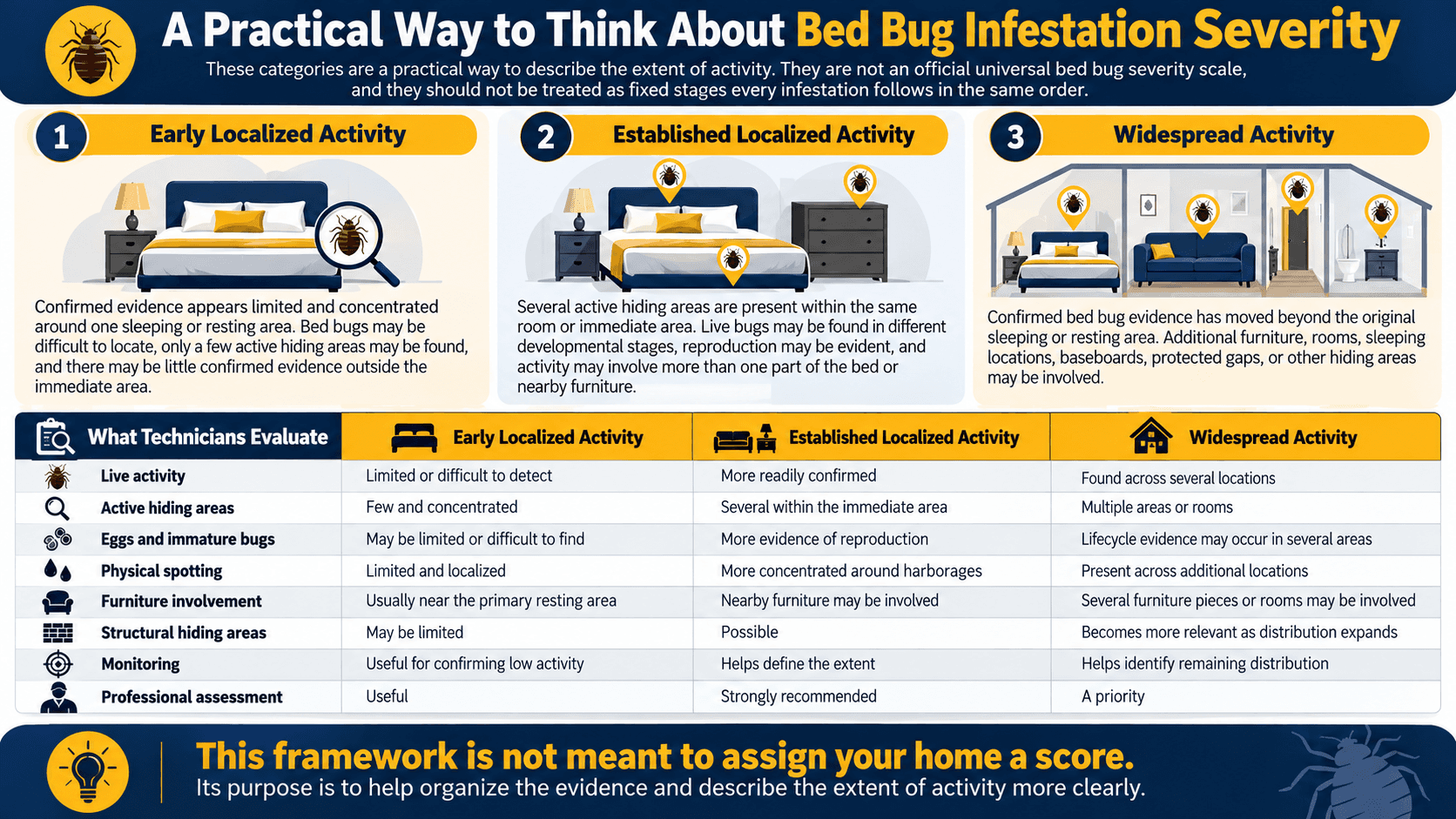
Established localized activity means several active hiding areas are present within the same room or immediate area. Live bugs may be found in different developmental stages, reproduction may be evident, and activity may involve more than one part of the bed or nearby furniture.
Widespread activity means confirmed bed bug evidence has moved beyond the original sleeping or resting area. Additional furniture, rooms, sleeping locations, baseboards, protected gaps, or other hiding areas may be involved.
What technicians evaluate | Early localized activity | Established localized activity | Widespread activity |
|---|---|---|---|
Live activity | Limited or difficult to detect | More readily confirmed | Found across several locations |
Active hiding areas | Few and concentrated | Several within the immediate area | Multiple areas or rooms |
Eggs and immature bugs | May be limited or difficult to find | More evidence of reproduction | Lifecycle evidence may occur in several areas |
Physical spotting | Limited and localized | More concentrated around harborages | Present across additional locations |
Furniture involvement | Usually near the primary resting area | Nearby furniture may be involved | Several furniture pieces or rooms may be involved |
Structural hiding areas | May be limited | Possible | Becomes more relevant as distribution expands |
Monitoring | Useful for confirming low activity | Helps define the extent | Helps identify remaining distribution |
Professional assessment | Useful | Strongly recommended | A priority |
The purpose of this framework is not to assign your home a score. It helps organize the evidence so a technician can determine whether activity is still concentrated or has become more distributed.
What does an early bed bug infestation look like?
An early bed bug infestation may involve limited confirmed activity around one bed, couch, recliner, or another place where someone regularly rests. An inspection may find only a small number of active hiding locations, and there may be no confirmed evidence yet in other rooms or furniture. The activity can be subtle enough that a quick visual check misses it entirely.
Early does not mean easy to find. Low level activity may be harder to locate because fewer bed bugs are present, hiding areas may be small, and physical evidence may be limited. Someone can spend several minutes inspecting a mattress and find nothing even when bed bugs are present elsewhere in the bed frame, headboard, box spring, furniture joint, or another protected location.
Severity and visibility are not the same thing. Seeing only one or two bed bugs does not prove that the infestation is new, and failing to find eggs during a quick inspection does not prove reproduction has not occurred. The more useful question is whether a careful inspection finds current activity concentrated in one area or evidence that the population has already moved beyond it.
This article does not repeat every identification detail for eggs, spotting, cast skins, and other evidence because Bed Bugs Undercover already covers those in its guide to the signs of bed bugs. Once the evidence has been identified, its location and pattern become more useful for estimating extent.
What does an established bed bug infestation look like?
An established bed bug infestation usually provides a broader pattern of current activity than a very localized problem. A technician may find several active hiding areas around the bed or nearby furniture instead of one isolated location. Live bugs may also be present in different developmental stages, with viable eggs and immature bed bugs found alongside adults.
Multiple active life stages can support the conclusion that reproduction is occurring, although they cannot tell you exactly when the infestation started. Finding adults, live nymphs, viable eggs, fresh spotting, and several active harborages around the same area gives a technician more information than finding one adult bed bug on its own. The interpretation comes from how the evidence fits together.
Distribution within the room also matters. Activity may no longer be limited to one mattress seam and may instead involve the box spring, bed frame, headboard, nightstand, nearby upholstered furniture, or other protected areas close to where someone rests. The number of hiding areas begins to matter because several active locations suggest the population is no longer confined to one small spot.
An established infestation can still be concentrated in one room. Finding substantial activity around one bedroom does not automatically mean bed bugs have spread throughout the entire house, which is why inspection should continue beyond the most obvious harborage before the extent is decided.
What makes a bed bug infestation widespread?
The term widespread is often more useful than severe because it describes something an inspection can evaluate directly: distribution. A bed bug infestation becomes more concerning when confirmed current activity is no longer limited to the original sleeping or resting area and begins appearing across additional furniture, rooms, or protected locations.
For example, finding active bed bugs in the bed and a nearby nightstand still describes a different pattern from finding them in the bed, a living room couch, and another occupied bedroom. The second situation demonstrates a broader distribution even if the homeowner has never seen a large cluster of bugs at one time. Bed bugs in multiple rooms can change how much of the property needs to be inspected and how a treatment plan is built.
As activity spreads, technicians may also need to inspect areas farther from the original bed. Baseboards, furniture joints, protected gaps, outlets, and other concealed areas can become relevant when the evidence suggests bed bugs are no longer staying close to one resting location. Finding one bug beside a baseboard does not automatically prove a widespread infestation, so the surrounding evidence still matters.
A widespread pattern is therefore based on confirmed activity across separate locations rather than a dramatic looking bug count. How far the infestation has spread is one of the strongest reasons a professional bed bug inspection can provide more useful information than estimating severity from what is visible on the mattress.
How important is where the bed bugs are found?
Location can be more informative than the number of bed bugs visible at one moment. Consider two homes where the homeowner has personally seen three bed bugs. In the first home, all confirmed activity is concentrated around one bed. In the second, current activity is found around the bed, inside a nearby chair, on a living room couch, and in another occupied bedroom.
A simple headcount would make the situations look similar even though their distribution is very different. The second property has confirmed activity across several resting areas and would require a broader assessment. The technician needs to understand not only whether bed bugs are present, but where active harborages exist and how those locations relate to where people sleep or spend long periods resting.
This is also why a detailed inspection often extends beyond the mattress. Bed frames, headboards, box springs, nearby furniture, furniture joints, baseboards, and concealed areas may all matter depending on what the initial inspection finds. A professional bed bug inspection is intended to determine where current activity exists and how far that activity appears to extend.
How many bed bugs does it take to have an infestation?
There is no universal number of visible bed bugs that separates a small infestation from a severe one. One confirmed bed bug is enough to justify investigation, but a single sighting does not tell you how many additional bed bugs may be hidden. Several visible bugs also do not provide a reliable census of the population.
Bed bugs are not usually sitting in open areas waiting to be counted. The number someone sees depends on where they looked, when they looked, how accessible the hiding areas are, and whether the bugs were active at the time. Two people with infestations of different sizes could easily report seeing the same number of bugs.
Evidence across multiple hiding locations provides more context than a simple count. Live nymphs, viable eggs, adults, current spotting, and active harborages found across several areas can tell a technician more about the condition of the infestation than the fact that a homeowner happened to see four bugs this week.
Finding one bed bug therefore should not be dismissed, and finding several should not be converted into an invented severity score. Investigation is more useful than counting.
Do eggs, nymphs and adults tell you how established the problem is?
Life stages can help a technician understand what is currently happening within the infestation. A live adult confirms current activity, but an adult alone does not reveal the full extent of the problem. Viable eggs indicate egg laying has occurred, while live nymphs show that immature bed bugs are present.
Finding active evidence across several life stages can support the conclusion that the population is reproducing. Adults, live nymphs, and viable eggs found together across active harborages provide a different picture from one isolated adult found on luggage or clothing. Even then, the life stages cannot be used to calculate an exact start date for the infestation.
Historical evidence also needs to be separated from current activity. Empty eggshells and old cast skins can remain after earlier bed bug activity and may still be present after treatment or after bugs have moved from a particular location. A technician therefore needs to determine whether the evidence is active, recent, or historical before using it to judge the current extent of the infestation.
Can old bed bug evidence make an infestation look worse than it is?
Yes, if every piece of evidence is counted as though it represents current activity. Bed bug harborages can contain old cast skins, empty eggshells, staining, and other evidence left behind from previous activity. Some of those signs can remain even when the current population in that exact location has changed.
The distinction becomes particularly important after treatment. Old physical evidence may still be visible after live activity has been reduced, so finding a cast skin does not automatically mean the infestation remains heavy. A fresh active harborage containing live bugs should be interpreted differently from a location containing only historical evidence.
Evidence | What it can tell you |
|---|---|
Live bed bug | Current activity is present |
Viable egg | Current or recent reproductive activity |
Live nymph | An active immature population is present |
Fresh active harborage | Current concentrated activity |
Old cast skin | Bed bug activity occurred at some point |
Empty eggshell | An egg hatched previously |
Historic spotting | Evidence that needs surrounding context |
This difference between current and historical evidence is one reason bed bug infestation assessment requires interpretation instead of simply adding up every sign in the room. The technician needs to ask what is active now and where that current activity is occurring.
Do more bites mean you have more bed bugs?
The number of bite like reactions on a person's skin cannot reliably tell you how large a bed bug infestation is. People respond differently to bed bug bites, and some people may show little visible reaction even when they have been exposed. Skin reactions can also vary from one exposure to another.
A person waking up with numerous marks does not automatically have a larger infestation than someone who notices only one or two. Bite appearance cannot show how many bed bugs are present, where they are hiding, whether they are reproducing, or how far they have spread through the property.
Physical evidence carries more weight when severity is being assessed. If you are still relying mainly on skin reactions and have not confirmed bed bug evidence in the home, review the signs of bed bugs before trying to grade the infestation.
Does seeing bed bugs during the day mean the infestation is severe?
A daytime sighting should get your attention, but it does not provide a reliable severity grade by itself. Bed bugs are commonly associated with activity when people are resting, yet individual bugs can still be seen during the day for different reasons. One bug crossing a wall at noon cannot tell you how many bed bugs are hidden elsewhere.
Daytime activity becomes more meaningful when it occurs alongside stronger evidence. Several active harborages, multiple life stages, concentrated current spotting, and confirmed activity in several locations create a broader pattern that can support an assessment of established or widespread activity.
The daytime sighting is therefore one piece of the inspection rather than the diagnosis. Its location and the evidence surrounding it matter more than the clock alone.
Does a strong musty smell mean the infestation is severe?
A persistent sweet or musty odor is sometimes associated with more established bed bug activity, but smell should not be used as a severity test on its own. Odor perception varies between people, and a homeowner may not know whether the smell is actually related to bed bugs without other evidence.
A technician would interpret odor alongside live activity, hiding locations, eggs, nymphs, spotting, and distribution. A strong smell combined with several active harborages may add useful context, while an unexplained odor without confirmed bed bug activity does not establish infestation severity.
The same principle applies throughout the assessment. No single symptom should be asked to carry more certainty than the evidence supports.
Can a small infestation have been present for a long time?
Severity is not the same as age. A problem that looks limited during an inspection cannot automatically be described as brand new, and widespread activity cannot tell a homeowner the exact day or week the infestation began.
Several factors can affect what is found during an inspection. Access to people, room use, temperature, available hiding areas, how easy those hiding areas are to inspect, and previous treatment can all change the pattern of visible evidence. Some infestations may remain difficult to detect for a period of time, while others become noticeable sooner.
Life stages also cannot be converted into a precise household timeline. Finding adults, nymphs, and eggs can show that reproduction is occurring or has occurred, but it does not establish an exact infestation age. Any article claiming that a specific visual pattern proves bed bugs have been present for an exact number of weeks is providing more certainty than the evidence supports.
Can DIY treatment make the infestation harder to assess?
Previous treatment can change what a technician finds during an inspection. Spraying visible areas may remove some accessible bugs or evidence while hidden activity remains elsewhere. Moving furniture between rooms can also change where evidence appears, especially if items from a known activity area are relocated.
DIY treatment does not automatically make every infestation spread, and retail products should not be blamed for every difficult inspection. The important point is that the technician needs an accurate treatment history before interpreting the evidence. Knowing what products were used, which rooms were treated, when treatment occurred, and whether furniture was moved provides useful context.
Avoid hiding previous treatment because it did not work as expected. The information helps explain why certain areas may show less visible evidence and why other hiding locations deserve additional attention.
How does a professional determine how extensive the infestation is?
A professional bed bug inspection looks beyond the question of whether one bug can be found. The inspection is intended to determine where current activity exists, where it is concentrated, whether additional locations are involved, and what evidence suggests about reproduction and distribution.
Areas commonly evaluated can include mattress seams, box springs, bed frames, headboards, nearby furniture, furniture joints, baseboards, and protected structural areas when the evidence warrants a broader search. Outlets, gaps, and other concealed locations may become relevant when activity is no longer limited to the immediate bed area. Monitoring can also help when live activity is difficult to locate during one visual inspection.
The technician is effectively answering several connected questions. Is the evidence current? Where are the active harborages? Does the infestation remain around one resting area? Are live nymphs, viable eggs, and adults present together? Has activity reached additional furniture or rooms? Previous treatment history may also change how the evidence is interpreted.
Those answers help define the extent of the infestation without relying on an arbitrary bug count. Bed Bugs Undercover offers a professional bed bug inspection for homeowners who have confirmed or convincing evidence and need to know how far the activity appears to have spread.
Does infestation severity change the treatment plan?
Yes. Inspection findings can influence which treatment approach is appropriate because two bed bug infestations can involve different hiding locations, distribution patterns, and property conditions. A localized problem around one resting area does not necessarily call for the same plan as confirmed activity across several rooms and furniture pieces.
Bed Bugs Undercover offers multiple bed bug treatment options rather than assuming one method fits every infestation. The treatment recommendation can be matched to where the bed bugs are hiding and how extensive the activity appears to be.
This article is focused on assessing severity rather than comparing every available treatment method. The useful sequence is to confirm the evidence, determine the extent of current activity, and then select the treatment approach that fits what the inspection found.
How bad does an infestation need to be before you call a professional?
You do not need to find dozens of bed bugs before an inspection becomes appropriate. A confirmed live bed bug deserves investigation because the one visible insect cannot tell you whether additional activity is hidden nearby. Repeated convincing evidence also deserves attention even when the homeowner has seen only a few bugs.
Professional assessment becomes particularly useful when eggs or live immature bed bugs are present, evidence appears in several locations, activity has moved beyond the original sleeping area, or old and current evidence are difficult to separate. Waiting for the infestation to become obviously widespread does not make the severity easier to manage.
The goal is not to create fear around one sighting. Determining the extent earlier gives the technician better information for deciding what areas need attention and which treatment approach fits the property.
Bed bug infestation assessment in Kingsport
Homeowners dealing with a bed bug infestation in Kingsport do not need to estimate severity by counting bites or trying to decide whether three visible bugs are better than ten. Bed Bugs Undercover evaluates the location and extent of confirmed activity and uses the inspection findings to determine what areas are involved.
The company specializes in bed bug work and provides inspection, treatment, monitoring, and follow up services. Its treatment approach can vary according to the infestation and the property rather than applying the same method automatically to every home.
Homeowners who already know they have bed bugs can review bed bug treatment in Kingsport, TN after the extent of the activity has been assessed. The inspection remains the more useful starting point when the main question is how established or widespread the problem has become.
Frequently asked questions about bed bug infestation severity
Q.1 How can I tell how bad my bed bug infestation is?
Do not judge severity from bites or from the number of bugs you happen to see. A more useful assessment looks at where current live activity is found, whether reproduction is evident, how many active hiding areas exist, and whether bed bugs have spread into additional furniture or rooms. A professional inspection can put those pieces together.
Q.2 How many bed bugs count as an infestation?
There is no universal visible bug count that defines an infestation or assigns its severity. One confirmed bed bug warrants investigation because additional bugs may be hidden. Several visible bugs still cannot tell you the size of the complete population without looking at active harborages, life stages, and distribution.
Q.3 Does finding one bed bug mean my home is infested?
One bed bug confirms that a bed bug is present, but it does not reveal whether the insect is isolated or part of a larger hidden population. The surrounding area should be inspected for additional live activity, eggs, immature bugs, spotting, and active hiding locations before conclusions are made about extent.
Q.4 What does an early bed bug infestation look like?
Early localized activity may be limited to one sleeping or resting area with relatively few confirmed active hiding locations. Evidence can be subtle and difficult to detect, which means an early infestation is not necessarily easy to find. Lack of obvious widespread evidence does not establish exactly when the problem began.
Q.5 What are signs that bed bugs have spread?
Confirmed activity in additional furniture, another bedroom, a couch, or other occupied resting areas suggests broader distribution than activity limited to one bed. Evidence around protected structural locations can also matter when it occurs alongside confirmed activity elsewhere. Distribution should be established through inspection rather than one isolated sighting.
Q.6 Do more bites mean there are more bed bugs?
No reliable infestation count can be made from bite like reactions. People respond differently, and some may show little visible reaction. Severity should be assessed using physical evidence, active hiding areas, reproduction, and distribution rather than the number of marks on someone's skin.
Q.7 Does seeing a bed bug during the day mean the infestation is severe?
A daytime sighting does not prove a severe infestation. It becomes more useful when considered alongside several active harborages, multiple life stages, concentrated spotting, and activity in more than one location. The sighting itself is only one piece of evidence.
Q.8 Can a professional inspection determine how extensive the infestation is?
Yes. An inspection can identify where current activity is concentrated, whether reproduction is evident, whether additional furniture or rooms are involved, and which evidence appears active rather than historical. Those findings provide a much better basis for estimating bed bug infestation severity than visible bug counts alone.
Concerned about how far the bed bugs have spread?
You do not need to estimate the infestation from bites or count every bed bug you can see before asking for help. A professional inspection can determine where current activity is concentrated, whether active reproduction is evident, and whether bed bugs have reached additional furniture, rooms, or protected hiding locations.
Bed Bugs Undercover provides inspections and treatment for bed bug problems in Kingsport and surrounding areas. You can schedule a professional bed bug inspection or call or text (423) 534-9771 to have the activity assessed before choosing a treatment plan.