How Long Does Bed Bug Treatment Take in Kingsport, TN?
Learn how long bed bug treatment takes in Kingsport, TN, including heat, conventional treatment, follow up visits, monitoring, and what can affect the timeline.

Once bed bugs are confirmed in a home, one of the first practical questions is usually about time. How long will treatment take? How long will you need to be away from the house? Will one appointment be enough, or should you expect technicians to return?
The difficulty is that there is no single timeline that answers all of those questions. A treatment appointment may take part of a day, while the complete treatment program can continue through follow up visits and monitoring. A home may also be ready to reenter well before there is enough evidence to consider the infestation fully cleared.
For Kingsport homeowners, the most accurate timeline starts with a professional bed bug inspection. The treatment method, number of affected rooms, severity of the infestation, location of hidden activity, previous treatment attempts, and follow up findings can all influence how long the process takes.
How Long Does Bed Bug Treatment Take in Kingsport, TN?
Professional bed bug treatment can range from one primary treatment day to a treatment program that continues across multiple visits. The important distinction is between how long technicians are actively treating the property and how long the complete elimination process takes.
Bed Bugs Undercover offers several treatment methods rather than applying the same process to every property. Thermal heat treatment keeps the treatment area above 122°F for several hours. Conventional treatment includes a minimum of two visits. Aprehend continues working as bed bugs move through treated areas, while combination treatment may intentionally use several methods or stages.
Monitoring and follow up then provide the information needed to determine whether activity remains.
Bed Bug Treatment Timelines at a Glance
Treatment Stage | Bed Bugs Undercover Process | What It Means |
|---|---|---|
Inspection | Completed before selecting treatment | Determines where activity is located and which treatment approach is appropriate |
Thermal heat | Treatment area remains above the required temperature for several hours | Often completed during one primary treatment day |
Conventional treatment | Minimum of two visits | Residual products continue working between visits |
Aprehend | Works after bed bugs contact treated areas | Exposed bugs generally die within approximately four to ten days |
Combination treatment | Uses multiple methods according to inspection findings | May include an immediate treatment followed by residual treatment, monitoring, or additional service |
Monitoring | Continues after treatment | Helps identify remaining or renewed activity |
Clearance | Determined through follow up findings | Finishing treatment is not automatically the same as confirming clearance |
Why There Is No Single Bed Bug Treatment Timeline
Two homes in Kingsport can have bed bugs and still require very different treatment plans.
One household may have a relatively recent infestation concentrated around a single sleeping area. The harborage sites may be accessible, no previous treatment may have been attempted, and inspection findings may indicate that activity has not spread far beyond the original room. Another property may have activity across several bedrooms, upholstered furniture, structural gaps, or areas where bed bugs have remained undisturbed for a longer period.
Previous attempts at treatment can also complicate the situation. Random spraying does not necessarily reach the locations where bed bugs are hiding, and poorly targeted applications can make the distribution of activity harder to assess. Apartments and other multi unit properties introduce another consideration because the source of continued activity may not always be limited to one room or one unit.
Treatment method is therefore only part of the timeline. The extent and distribution of the infestation determine what needs to happen before, during, and after the primary treatment.
How Long Does a Bed Bug Inspection Take?
Inspection comes before a reliable treatment timeline can be given because the technician first needs to understand what is happening inside the property.
During bed bug inspection and monitoring, technicians may examine mattress seams, box springs, bed frames, headboards, furniture joints, baseboards, electrical areas, cracks, crevices, and other potential harborage locations. The purpose is not simply to locate a visible bed bug. A useful inspection needs to establish how far the activity extends and which treatment method fits the conditions found inside the home.
A small property with evidence concentrated around one bed naturally presents a different inspection scope from a larger home where several rooms are involved. Complex furniture, structural hiding areas, and uncertain infestation history can also increase the amount of assessment required.
Once the inspection establishes the extent of activity, the treatment timeline becomes much easier to define.
How Long Does Thermal Heat Treatment Take?
Professional thermal heat treatment for bed bugs is generally the fastest treatment option offered by Bed Bugs Undercover when measured by the primary treatment itself.
During treatment, the affected area is raised above 122°F and kept at treatment temperature for several hours. Sensors are used to monitor conditions throughout the space so the process is based on temperatures reached in the areas being treated rather than simply the temperature of the surrounding air.
This distinction matters because bed bugs do not spend all of their time exposed on mattresses or bedding. They can hide inside furniture, behind structural materials, around bed frames, and in protected cracks and spaces. Effective thermal treatment therefore depends on heat reaching the locations where the insects may actually be sheltering.
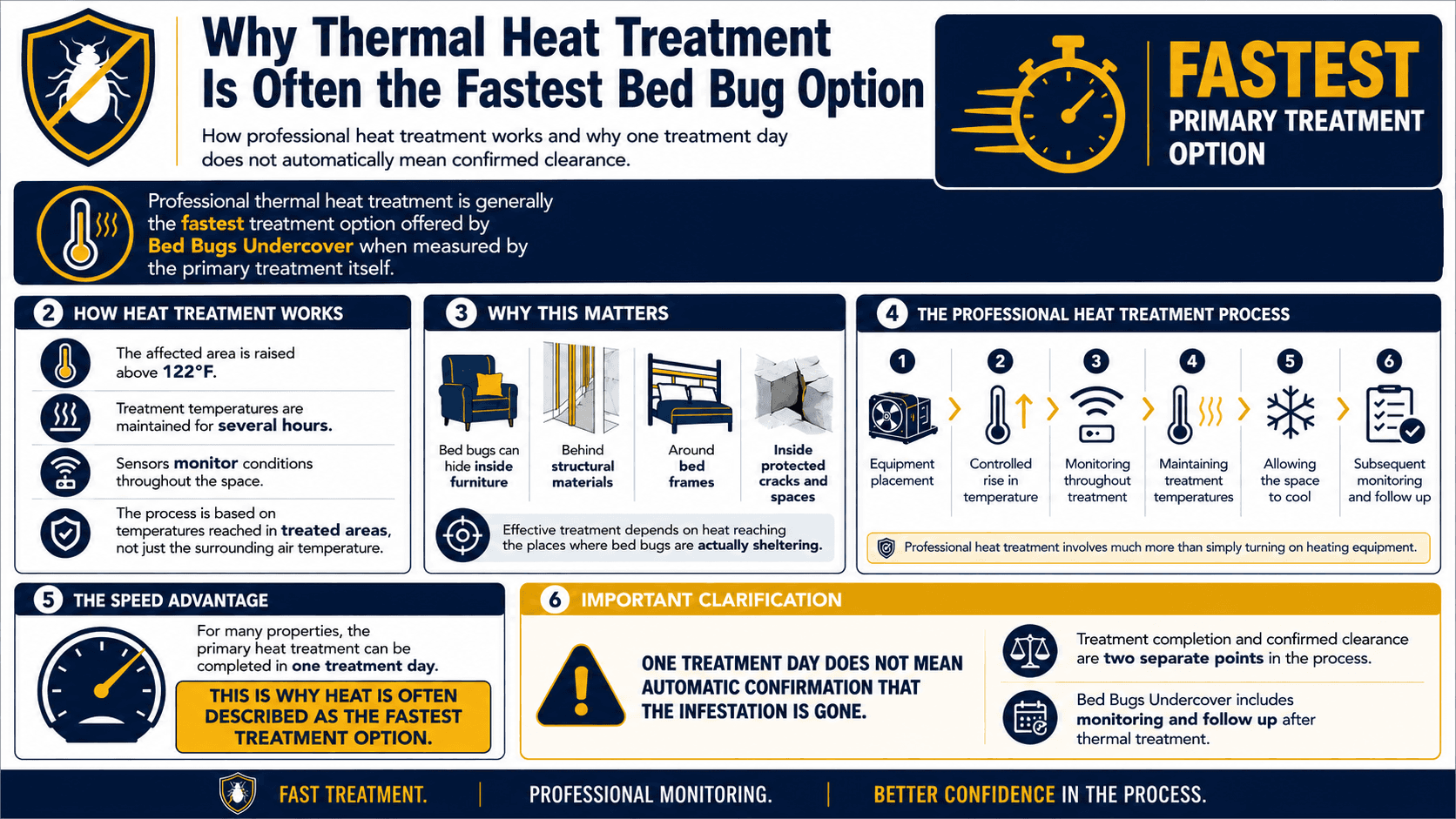
A professional heat treatment involves more than turning on heating equipment. The process includes equipment placement, a controlled rise in temperature, monitoring throughout treatment, maintaining treatment temperatures, allowing the space to cool, and conducting subsequent monitoring and follow up.
For many properties, the primary heat treatment can be completed in one treatment day. This is why heat is often described as the fastest treatment option.
One treatment day, however, should not be confused with automatic confirmation that the infestation is gone. Bed Bugs Undercover includes monitoring and follow up after thermal treatment because treatment completion and confirmed clearance are two separate points in the process.
When Can You Return Home After Heat Treatment?
Bed Bugs Undercover states that customers receiving thermal heat treatment can generally return to the property the same evening.
Residents remain out of the treatment area while the heat process is underway. Once treatment has been completed, the equipment has been removed, and conditions have been brought back to an appropriate level, the technician can provide instructions for returning to the home.
The exact sequence depends on the property and treatment conditions, which is why a universal reentry time should not replace instructions from the technician handling the job.
Returning home also does not end the treatment process from a monitoring perspective. Follow up is still important even when the primary thermal treatment has already been completed.
How Long Does Conventional Bed Bug Treatment Take?
Conventional bed bug treatment works on a different timeline from heat.
Bed Bugs Undercover's conventional bed bug treatment includes a minimum of two visits. Professional liquid formulations are applied to appropriate harborage zones and travel areas, while dust or aerosol products may also be used where the inspection shows they are appropriate.
The first appointment is therefore only one part of the conventional program. Residual treatment remains in place after the technician leaves and continues affecting bed bugs as they move through treated locations.
Monitoring devices are placed throughout treated areas so activity can be assessed between visits. During follow up, technicians inspect those devices, evaluate the level of remaining activity, and apply additional treatment where needed. If evidence shows that bed bugs remain after the second visit, treatment can continue during the company's 90 day coverage period.
This process explains why asking how long chemical bed bug treatment takes can produce a misleading answer if the response only describes the first appointment. The technician may finish the initial application that day, while the treatment program remains active afterward.
Why Does Conventional Treatment Usually Require More Than One Visit?
Bed bugs are difficult to treat partly because of where they spend their time. Much of an infestation may be hidden in protected areas rather than sitting on exposed surfaces where it can be treated immediately.
A residual program takes advantage of the insects' continued movement. Bed bugs that were concealed during the initial treatment can encounter treated surfaces later. Follow up also gives the technician an opportunity to see whether activity is declining as expected or whether additional locations require attention.
Eggs are another reason the timeline cannot always be reduced to a single application. Conventional treatment is structured around repeated assessment, residual activity, monitoring, and further treatment when evidence remains.
Bed Bugs Undercover therefore does not treat the second visit as an indication that the first visit failed. Multiple service points are built into the conventional program from the beginning.
How Long Does Aprehend Take to Work?
Aprehend biopesticide treatment operates differently from both heat and a traditional pesticide application.
Aprehend uses Beauveria bassiana fungal spores applied along selected bed bug travel routes and harborage areas. Bed bugs must move through the treated zone and pick up the spores. They can then transfer those spores through contact with other bed bugs.
According to Bed Bugs Undercover's treatment information, bed bugs that come into contact with the spores generally die within approximately four to ten days. Treated surfaces can remain active for up to 90 days, allowing the treatment to continue intercepting bed bugs that cross those areas later.
The four to ten day figure refers to what happens after a bed bug has been exposed. It should not be interpreted as a promise that an entire infestation will disappear within four to ten days.
The complete Aprehend treatment timeline depends on where bed bugs are located, how they move through the property, whether they cross the treated areas, and what subsequent monitoring reveals. Bed Bugs Undercover uses monitoring devices and follow up visits to assess activity and determine whether the elimination process is progressing.
How Long Does Combination Bed Bug Treatment Take?
Some infestations benefit from using more than one treatment method.
Combination bed bug treatment may pair thermal heat, conventional treatment, Aprehend, monitoring, or additional treatment methods according to the conditions found during inspection. A primary treatment may address immediate activity, while a second treatment layer adds residual protection or targets locations that require a different approach.
A property could therefore receive heat treatment during one primary service day and still have residual treatment, monitoring, or follow up afterward. Additional stages do not automatically indicate that the initial treatment was unsuccessful.
A longer treatment plan can be intentional. Different methods solve different parts of the problem, particularly when an infestation is severe, spread across multiple rooms, associated with a rental property, or has returned after previous treatment.
What Can Make Bed Bug Treatment Take Longer?
Several factors can change how quickly a property moves from the initial inspection to confirmed clearance.
Infestation Severity
An established infestation can involve a larger number of insects and a greater number of harborage sites. Activity may extend beyond the bed into nearby furniture, walls, baseboards, or other protected areas.
More extensive activity usually requires broader inspection and monitoring. The treatment plan also needs to account for each affected location rather than concentrating only on the place where a bed bug was first noticed.
Number of Affected Rooms
Bed bugs restricted to one sleeping area create a different treatment scope from activity discovered across several bedrooms or living spaces.
Multiple affected rooms increase the number of places technicians need to inspect, treat, and monitor. Distribution becomes especially important when occupants regularly sleep or rest in several parts of the property.
Property Size and Layout
Larger homes naturally contain more potential hiding areas. Complex layouts, heavily furnished spaces, and properties divided into separate units can also require additional assessment.
The number of square feet alone does not determine treatment difficulty. The way people use the property and the locations available for bed bugs to hide can matter just as much.
Hidden Harborage Areas
Bed bugs can shelter inside furniture construction, narrow gaps, wall voids, baseboards, and other protected spaces. Surface treatment alone may not adequately address activity in these areas.
Bed Bugs Undercover can use dust and aerosol bed bug treatment where inspection findings indicate activity in cracks, crevices, structural gaps, furniture joints, or other difficult locations.
Previous DIY Treatment
Previous spraying can make an infestation more complicated to assess when products were applied without a clear understanding of where the insects were harboring.
Visible bugs may have been killed while hidden activity remained elsewhere. Bed bugs may also be found in different areas after repeated attempts to treat only the obvious locations.
Reintroduction
Successful treatment does not prevent a new bed bug from being carried into the property later.
Travel, overnight guests, secondhand furniture, and movement between properties can create another introduction. Apartments and other multi unit environments may require additional attention if continuing activity suggests the source extends beyond the originally treated space.
Treatment Method
Heat, conventional treatment, Aprehend, and combination treatment are designed to work differently.
A treatment that takes longer is not necessarily less effective. The relevant question is whether the treatment timeline matches the biology of the infestation and the conditions found in the property.
Does a Severe Infestation Always Take Longer?
Severity often affects treatment duration, although the relationship is not always as simple as counting visible bed bugs.
A severe infestation may involve more rooms, additional furniture, deeper harborage locations, and wider distribution throughout the structure. Monitoring may also need to cover a larger area so technicians can determine whether activity remains outside the most obvious locations.
Treatment method still influences the overall timeline. A well planned treatment for a significant infestation may have a different schedule from a smaller infestation treated through a residual program.
The correct sequence remains the same: inspection first, treatment recommendation second.
How Long Before Bed Bugs Are Completely Gone?
A day without seeing a bed bug is encouraging, but it is not the same as having enough evidence to conclude that the infestation has cleared.
Bed bugs are naturally difficult to observe because they spend much of their time concealed. Immediate visual absence after treatment therefore provides limited information on its own. Monitoring and follow up give the technician a better basis for deciding whether activity has stopped.
The treatment method also changes what should be expected. Conventional residual products continue working after the first appointment. Aprehend depends on bed bugs crossing treated areas. Heat follows a more immediate primary treatment model, while combination treatment can intentionally continue across several stages.
Bed Bugs Undercover provides 90 day coverage and incorporates follow up into its treatment process. The goal is not merely to finish the application. The goal is to have enough follow up information to determine whether the infestation has actually cleared.
Why Monitoring Is Part of the Treatment Timeline
Bed bug monitoring is not simply an optional extra added after treatment.
Monitoring provides information about what is happening when technicians are no longer physically inside the home. Devices placed in treated areas can reveal continuing activity, help measure how the treatment is progressing, and give technicians evidence to review during follow up.
This information becomes particularly valuable when deciding whether another treatment is needed. A single sighting may need context, while a pattern of continued activity can indicate that more work is required.
Monitoring also helps distinguish continuing infestation from possible new introduction. Treatment and monitoring therefore work together rather than functioning as separate services.
Is It Normal to See a Bed Bug After the First Treatment?
Seeing a bed bug after treatment does not have the same meaning in every treatment program.
After conventional treatment, residual products remain active after the technician leaves. A bed bug emerging from a protected hiding area may still encounter treated surfaces later. The follow up visit is used to examine monitoring results, assess activity, and apply more treatment where evidence indicates it is needed.
Aprehend also requires exposure. Bed bugs need to cross the treated areas and pick up fungal spores before the treatment can affect them, so its timeline is deliberately different from an immediate contact treatment.
Thermal heat treatment follows another model because the treatment area is brought above the required temperature during the service itself.
A post treatment sighting therefore needs context. The useful question is whether the activity fits the expected treatment process or whether it suggests continuing or renewed infestation.
Is One Bed Bug Treatment Enough?
The answer depends on what is meant by one treatment.
Thermal heat may involve one primary treatment day, followed by monitoring and a follow up visit. Conventional treatment from Bed Bugs Undercover includes a minimum of two visits as part of the program.
Aprehend continues working after the application as bed bugs cross treated zones. Combination treatment may intentionally involve several methods and treatment stages.
Counting appointments is therefore a poor way to judge treatment quality. A treatment program should be evaluated according to the infestation, the method being used, and the evidence collected afterward.
How Much Time Will Bed Bug Treatment Disrupt Your Home?
Treatment time matters because homeowners are not only thinking about bed bugs. They are also thinking about work, children, pets, sleeping arrangements, furniture, clothing, and how quickly the household can return to normal.
Preparation can sometimes create as much inconvenience as the treatment itself. Bed Bugs Undercover uses a No Prep Protocol for conventional treatment, which means customers generally do not need to move furniture, bag all of their clothing, or empty dresser drawers before technicians arrive. The team handles the preparation required for treatment.
Thermal heat follows a different process and may require certain belongings to be addressed according to technician instructions. Residents also need to remain out of the treatment area during the heat process, although customers can generally return home the same evening after treatment is completed.
Follow up appointments add time to the complete program, yet they do not produce the same level of household disruption as repeating the primary treatment from the beginning. Understanding the complete schedule before treatment starts makes it much easier to plan around the process.
How Bed Bugs Undercover Approaches Treatment Timelines in Kingsport
Bed Bugs Undercover treats homes, apartments, rentals, and other properties throughout Kingsport and Sullivan County. Rather than assigning every infestation the same timetable, the company begins by determining the extent of activity and then matching the treatment method to the findings.
The process follows a practical sequence:
Inspection → Treatment Recommendation → Treatment → Monitoring → Follow Up
The team is led by an Associate Certified Entomologist and offers several professional treatment options, including conventional treatment, thermal heat, Aprehend, dust and aerosol applications, and combination treatment. The No Prep Protocol reduces the preparation burden for customers, while discreet service helps protect privacy during a problem many homeowners would rather keep private.
Monitoring, follow up visits, and 90 day coverage remain part of the broader treatment approach. For homeowners looking for bed bug treatment in Kingsport, TN, this means the treatment timeline is based on what is actually happening inside the property rather than a generic number of hours or days.
What Is the Fastest Way to Get the Right Treatment Started?
Choosing the treatment advertised as the fastest is not necessarily the quickest route to solving a bed bug problem.
A professional inspection can establish how extensive the infestation is, where activity is concentrated, and which treatment method makes sense for the property. Starting with the wrong method can waste more time than choosing a treatment with a longer planned schedule.
Bed Bugs Undercover offers multiple bed bug treatment options because bed bug infestations do not all behave the same way.
The fastest practical route is therefore straightforward: identify the infestation correctly, determine its extent, and build the treatment timeline around the evidence.
Frequently Asked Questions About Bed Bug Treatment Time
Q.1 How long does a typical bed bug treatment take?
The primary treatment may take one treatment day, while the complete program can continue through several visits depending on the method and infestation. Heat, conventional treatment, Aprehend, and combination treatment all operate on different timelines.
Q.2 How many bed bug treatments are usually needed?
There is no universal number. Bed Bugs Undercover's conventional treatment includes a minimum of two visits, while heat may involve one primary treatment day followed by monitoring and follow up.
Q.3 How long does bed bug heat treatment take?
Bed Bugs Undercover raises the treatment area above 122°F and keeps it at treatment temperature for several hours. The complete service also includes setup, temperature monitoring, cooling, and subsequent follow up.
Q.4 Can bed bugs be eliminated in one day?
Thermal heat may allow the primary treatment to be completed during one day. Completing the treatment day is different from confirming that no bed bug activity remains, which is why monitoring and follow up are still important.
Q.5 How long does conventional bed bug treatment take?
Conventional treatment is a multiple visit program. Bed Bugs Undercover includes at least two visits, uses residual treatment that continues working after the initial service, and reviews monitoring findings during follow up.
Q.6 How do I know when bed bugs are completely gone?
Monitoring and follow up provide a more reliable answer than simply waiting for a certain number of days. Technicians look for continuing activity and use follow up findings to determine whether additional treatment is necessary or whether the infestation has cleared.
Need Bed Bug Treatment in Kingsport?
An accurate bed bug treatment timeline starts by understanding the infestation rather than guessing how long treatment should take.
Bed Bugs Undercover can inspect the property, determine how far the activity has spread, and recommend the treatment method that fits the situation. Customers receive access to multiple treatment options, monitoring, follow up, and 90 day coverage rather than a single treatment approach applied to every home.
Start with a professional bed bug inspection, or learn more about bed bug treatment in Kingsport, TN.
Call or text Bed Bugs Undercover at (423) 534-9771.