Bed Bugs in Kingsport Apartments: How They Spread
Learn how bed bugs spread between Kingsport apartment units, what residents and landlords should do, and when professional inspection and treatment are needed.

Discovering bed bugs in an apartment often raises concerns that go beyond the room where the first evidence appears. A resident may wonder whether the insects came from a neighboring unit, while a landlord or property manager may need to determine whether the problem extends into other apartments. Those questions are reasonable because an apartment building creates more opportunities for bed bugs to move between living spaces than a detached home.
Bed bugs can spread from one apartment to another, although their presence does not automatically prove that a neighboring resident caused the infestation. Travel, visitors, luggage, secondhand furniture, previous tenant activity and personal belongings are all possible introduction routes. Once an infestation becomes established, bed bugs may also disperse through structural openings or be carried elsewhere in the building on possessions.
A successful response therefore depends on understanding the extent of the problem before treatment begins. For Kingsport apartment residents and property managers, a professional bed bug inspection can establish whether bed bugs are present, identify the areas where activity is concentrated and help determine whether surrounding units should also be evaluated.
Bed Bugs in Kingsport Apartments: How They Spread Between Units and What to Do
Bed bugs are capable of moving between apartments both on their own and through the movement of belongings. Research conducted in occupied apartment buildings has documented bed bugs dispersing into neighboring units, including apartments located beside, above and below an infested residence. Researchers have also recovered bed bugs in units across common hallways, demonstrating why apartment infestations sometimes require a wider investigation than the original complaint might suggest.
Active movement is only one part of the problem. Bed bugs are also highly effective hitchhikers and can be carried on luggage, clothing, bedding, bags, furniture and boxes. Apartment communities naturally involve frequent movement of people and possessions through hallways, shared entrances, laundry facilities and other common spaces, which creates additional opportunities for an unnoticed introduction.
The presence of bed bugs in one unit does not mean that every nearby apartment is infested. It does mean that the surrounding units deserve consideration during the investigation. University of Tennessee guidance for landlords and building managers recommends inspecting apartments adjacent to, above and below a unit where bed bugs have been confirmed.
Why Apartment Infestations Require a Different Approach
Bed bug biology does not change because someone lives in an apartment, although the building around the infestation changes the way the problem must be managed. A detached residence generally allows the technician to evaluate one household within one occupied structure. An apartment building introduces adjoining walls, ceilings, floors, utility penetrations, shared corridors and neighboring residences into the assessment.
Building layout can become particularly important when an infestation has existed for some time. Bed bugs are usually concentrated near sleeping and resting areas, yet research has shown that they can travel extensively throughout an infested apartment and disperse into neighboring residences. A technician therefore needs to understand more than what is visible along the edge of a mattress.
A thorough bed bug inspection and monitoring service examines likely harborage locations such as mattress seams, box springs, bed frames, headboards, furniture joints, baseboards, electrical areas and wall voids. Bed Bugs Undercover uses the inspection to determine the severity and distribution of the infestation before recommending a treatment plan.
How Bed Bugs Can Move From One Apartment to Another
The phrase “bed bugs coming through the walls” is often used to describe apartment infestations, although the actual movement can involve several different routes. Structural connections matter, but furniture, laundry and personal belongings can be equally important. Understanding these pathways helps residents avoid actions that may unintentionally move bed bugs into areas that were previously unaffected.
Small openings around baseboards, flooring, trim, wiring and utility penetrations can connect protected areas within a building. Bed bugs can occupy remarkably narrow spaces, which means a visible wall surface does not necessarily represent a complete barrier between living areas. Activity involving cracks, wall gaps, furniture joints or other protected harborage areas may require more targeted treatment than a standard surface application.
Electrical outlets are another source of confusion. Bed bugs are not attracted to electricity, although the space around an electrical box or wiring penetration may provide access to a wall cavity. Residents should never respond by spraying liquid pesticide into electrical equipment. When inspection findings show activity in protected structural areas, Bed Bugs Undercover can use professional bed bug dust and aerosol treatments designed for cracks, crevices, wall gaps, furniture construction and other difficult harborage locations.
Plumbing presents a similar situation. Bed bugs are not moving through the water inside a plumbing system, although gaps around pipes can create openings between cabinets, walls, floors and other structural spaces. A professional inspection considers these connections when the pattern of activity suggests that bed bugs have moved beyond the immediate sleeping area.
Movement through the structure is only one possibility. Mattresses, couches, boxes, laundry bags, luggage and other belongings can carry bed bugs through hallways or into another apartment. Removing furniture immediately after finding bed bugs can therefore create a new opportunity for spread, particularly when an untreated item is carried through a common corridor or placed somewhere another resident may retrieve it.
Could the Bed Bugs Have Come From a Neighboring Apartment?
Movement from a neighboring unit is possible, but location alone cannot establish the source of an infestation. Bed bugs may enter an apartment after a hotel stay, through luggage, on secondhand furniture, through visitors or from belongings that were exposed elsewhere. Previous tenant activity can also matter, particularly when a unit changes occupants without an existing infestation being identified.
Assigning blame before the surrounding area has been evaluated rarely improves the outcome. A more useful investigation asks where activity is present now, whether another apartment shows evidence and whether the pattern suggests movement beyond one residence. This approach also helps reduce the stigma that sometimes prevents residents from reporting bed bugs promptly.
Cleanliness is not a reliable explanation for why one resident develops an infestation and another does not. Bed bugs depend on access to people rather than dirty living conditions, and ordinary travel or movement of belongings can introduce them into well maintained properties. Earlier reporting gives property managers a better opportunity to investigate the affected area before the infestation has additional time to become established.
Which Neighboring Apartments Should Be Inspected?
The units directly beside an infested apartment are not the only residences that may deserve attention. University of Tennessee guidance recommends inspecting apartments adjacent to, above and below a confirmed infestation. EPA guidance similarly advises landlords to evaluate adjacent units and actively monitor treated apartments as part of an effective response.
Research into bed bug dispersal has documented both horizontal and vertical movement between apartments. Investigators in one field study monitored units above, below, beside and across the hallway from infested apartments and confirmed active dispersal into neighboring residences. The findings support expanding the investigation according to building layout and evidence rather than concentrating exclusively on the unit that generated the first complaint.
Inspection should not be confused with automatic treatment. A nearby apartment that shows no evidence may not require the same treatment as a confirmed unit, while a second positive apartment can justify expanding the scope of the investigation. The pest professional and property manager should make those decisions using inspection findings, monitoring results and knowledge of the building rather than assumptions.
What Should a Kingsport Apartment Resident Do After Finding Bed Bugs?
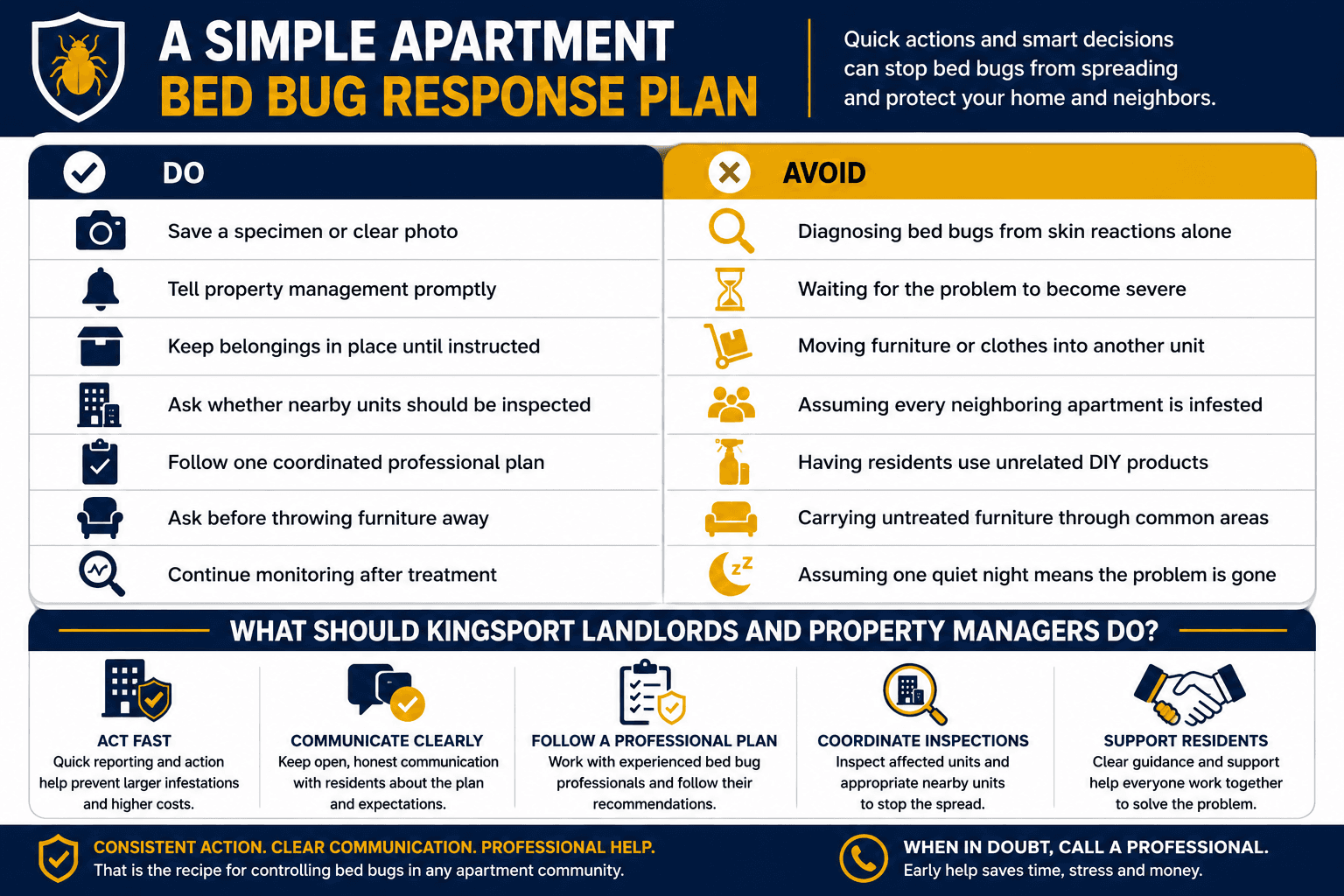
The first response should focus on preserving evidence and limiting unnecessary movement. A clear photograph or safely contained specimen can help with identification, particularly when the original concern began with an unfamiliar insect or marks on the skin. Bites alone cannot reliably confirm a bed bug infestation because skin reactions vary considerably and can have many causes.
Residents should notify the landlord or property manager promptly once bed bugs are suspected or confirmed. Written communication can help document when the issue was reported, where evidence was discovered and what inspection or treatment has been scheduled. Prompt reporting also gives management an opportunity to determine whether surrounding apartments need professional evaluation.
Belongings should remain in place unless the treatment plan provides different instructions. Moving bedding, clothing, luggage or furniture into another bedroom, vehicle, storage area or neighboring residence can transport bed bugs away from the original area. Carrying an untreated mattress or couch through a common hallway may create a similar risk.
Retail sprays and total release foggers should not be treated as substitutes for a coordinated apartment treatment plan. Bed bugs spend much of their time inside narrow harborage areas, and products applied without understanding the extent of the infestation may fail to reach the locations that matter. EPA guidance recommends determining the extent of an apartment infestation and notifying the landlord so nearby units can be evaluated when appropriate.
Bed Bugs Undercover offers conventional bed bug treatment using professional pesticide formulations selected for the areas where bed bugs hide and travel. The current conventional program includes residual treatment, a minimum of two visits, no customer prep requirement and a 90 day coverage period.
What Kingsport Landlords and Property Managers Should Do
A report from one resident should begin an investigation rather than an assumption that the entire property has become infested. Management should arrange confirmation promptly, document the affected unit and determine which surrounding residences need inspection. Delayed investigation gives an established infestation more time to disperse and makes it harder to understand where the original boundaries of the problem were located.
Coordinated access is particularly important when more than one apartment needs evaluation. Separate residents using unrelated products, moving belongings independently or refusing access can make the situation much harder to assess. A clear management process gives everyone the same instructions and allows the pest professional to track which apartments have been inspected, which show evidence and which require follow up.
Communication should remain factual and discreet. Bed bugs carry an unnecessary social stigma, and residents may avoid reporting an infestation if they believe their neighbors will immediately know why a pest control company is visiting. Bed Bugs Undercover uses discreet service vehicles without bed bug branding, a feature that can be especially valuable for apartment communities and rental properties where resident privacy matters.
Property managers should also plan beyond the initial treatment date. EPA recommends active monitoring after treatment, while Tennessee guidance emphasizes prompt reporting, inspection of surrounding units and professional pest management. A documented process for inspection, treatment and follow up gives the property a much stronger foundation than responding separately every time another resident reports a problem.
How Professional Bed Bug Treatment Works in Apartment Buildings
Apartment treatment should begin with the extent and location of the infestation rather than a preferred product or treatment technology. A unit with limited activity may present a very different situation from a property where several apartments show evidence or residents have already attempted repeated treatments. Bed Bugs Undercover offers several professional bed bug treatment options and selects the approach according to inspection findings.
Conventional Treatment
Professional conventional treatment uses pesticide formulations applied to active harborage and travel areas. Bed Bugs Undercover uses residual liquid applications along with dust and aerosol formulations where appropriate, giving the technician several ways to address different hiding environments. Residual activity can be useful in an apartment setting because treatment continues beyond the initial service rather than ending when the technician leaves.
The conventional program currently includes a minimum of two visits and a 90 day coverage period. Customers are not expected to move all furniture, bag every piece of clothing or empty every drawer before treatment under the company's No Prep Protocol. Residents should follow the instructions for the treatment selected for their apartment rather than relying on a generic preparation checklist.
Thermal Heat Treatment
Professional bed bug thermal heat treatment raises the temperature of the treatment area above 122°F and maintains treatment temperatures for several hours. Heat can reach eggs, immature bed bugs and adults when the necessary temperature reaches their hiding locations. Bed Bugs Undercover describes heat as its fastest treatment option and includes follow up and a 90 day coverage period.
Heat also has an important limitation in apartment settings because it does not provide continuing thermal protection after the space cools. An untreated infestation elsewhere in the building or a later introduction can therefore create activity again. The wider apartment investigation remains important even when heat is selected for a particular unit.
Aprehend
Aprehend bed bug treatment provides another professional option for situations involving hidden or recurring activity. Aprehend uses a biopesticide applied to selected travel and harborage zones, creating residual coverage in areas bed bugs are expected to cross. Bed Bugs Undercover recommends the method only when inspection findings indicate that it fits the infestation.
Apartment properties can present situations where residual treatment is particularly relevant, although Aprehend should not be presented as the universal answer for every multi unit infestation. Property conditions, the number of affected units, previous treatment history and the distribution of activity all influence the recommendation. Professional judgment is more valuable than selecting a treatment based solely on a product name.
Combination Treatment
More complex infestations may require several treatment tools rather than repeated use of one method. Bed Bugs Undercover's combination bed bug treatment can incorporate heat, conventional treatment, Aprehend, monitoring or follow up work according to the inspection findings. The company identifies severe infestations, multiple room activity, rental properties and repeat infestations among the situations where a combined strategy may be useful.
A combined approach is not valuable simply because it uses more treatment. Its value comes from assigning the appropriate method to the parts of the infestation where it makes sense. Apartment buildings often require this kind of judgment because one unit may have different conditions from the residence next door.
Why Monitoring and Follow Up Matter
The absence of a visible bed bug immediately after treatment does not establish that the infestation has been eliminated. Monitoring gives the technician another source of information during the period after service and can help determine whether activity remains in the treated apartment. The same process becomes more important when nearby residences have also shown signs of infestation.
Bed Bugs Undercover places monitoring devices after treatment and returns for follow up visits to evaluate continuing activity. Its current treatment process follows a sequence of inspection, treatment, monitoring and follow up, supported by a 90 day coverage period.
Recurring activity also deserves investigation rather than an immediate assumption that a treatment simply failed. Remaining bed bugs, an overlooked harborage area, movement from another apartment or a completely new introduction can produce similar observations from the resident's perspective. Inspection and monitoring help distinguish between those possibilities before another treatment decision is made.
Do Residents Need to Bag Everything or Throw Away Their Furniture?
Extensive preparation is one of the reasons apartment residents sometimes delay professional treatment. People may expect to bag their entire wardrobe, empty every drawer, dismantle furniture and move most of their belongings before a technician arrives. Bed Bugs Undercover uses a No Prep Protocol that removes much of this burden for its conventional treatment program.
Thermal heat requires a different level of preparation because certain items can be sensitive to treatment temperatures. Customers receive instructions for the treatment that has actually been recommended instead of being asked to follow the same preparation list for every method. This approach is especially useful in apartments, where unnecessary movement of belongings can create additional opportunities for bed bugs to be carried elsewhere.
Furniture should also be evaluated before disposal. A mattress, couch or chair containing bed bugs may still be treatable, while carrying the item through hallways, elevators or stairwells can move insects away from the original unit. Residents should speak with the technician and property manager before deciding that furniture has to leave the apartment.
Professional Bed Bug Help for Kingsport Apartments
Kingsport includes a mix of owner occupied homes, rentals, apartment communities and other multi residence properties, and each infestation needs to be evaluated on its own conditions. Bed Bugs Undercover provides bed bug treatment in Kingsport, Tennessee and serves apartment residents, landlords and property managers throughout Kingsport and Sullivan County. The company is led by James Brashears, an Associate Certified Entomologist, and specializes specifically in bed bug inspection and treatment.
Treatment recommendations can include conventional pesticide treatment, thermal heat, Aprehend, combination treatment and targeted dust or aerosol applications according to what the inspection reveals. Monitoring and follow up are built into the treatment process, while discreet vehicles help protect privacy in settings where neighbors live only a few doors away. The objective is to establish the true extent of the infestation and select the treatment that matches the property rather than applying the same program to every apartment.
Residents who suspect bed bug activity should avoid moving belongings or beginning an unplanned treatment campaign before the situation has been evaluated. Property managers should focus on prompt confirmation, appropriate surrounding unit inspections and coordinated treatment when additional activity is discovered. Starting with accurate information usually produces a much clearer path forward.
Frequently Asked Questions About Bed Bugs in Kingsport Apartments
Q.1 Can bed bugs travel through apartment walls?
Bed bugs can move through small structural openings and protected wall spaces in some apartment buildings. Gaps around wiring, utility penetrations, baseboards and other construction features may provide routes between areas. Structural movement is only one potential route because bed bugs can also be carried between locations on belongings.
Q.2 Can bed bugs come through electrical outlets?
Bed bugs may use gaps around electrical boxes and wiring to enter or leave protected wall spaces. Electricity itself does not attract them, and residents should not apply liquid pesticides inside electrical equipment. Professional treatment can address appropriate wall voids or structural harborage areas when inspection findings justify it.
Q.3 Can bed bugs move between apartments through plumbing?
Bed bugs do not normally travel through the water inside plumbing pipes. Spaces around pipe penetrations can connect protected areas within walls, cabinets or floors, making those gaps more relevant than the plumbing system itself. A technician may consider these structural features when evaluating an apartment infestation.
Q.4 Can bed bugs come from an apartment above or below?
Yes. Field research has documented bed bug movement both horizontally and vertically between apartments, and Tennessee guidance recommends inspecting units above and below a confirmed infestation. Nearby units should be evaluated according to the building layout and evidence rather than automatically assumed to be infested.
Q.5 Does every apartment next to an infestation need treatment?
Not necessarily. Surrounding apartments should be considered for inspection, while treatment decisions depend on the findings and the pest professional's assessment. EPA advises landlords to evaluate adjacent units, although some researchers recommend broader adjacent unit treatment in certain circumstances.
Q.6 Can bed bugs spread through a shared laundry room?
Bed bugs can be transported on clothing, bedding, laundry bags and other items carried through shared spaces. The greater concern is the movement of infested belongings rather than the laundry room itself automatically becoming a source. Residents with confirmed bed bugs should follow professional instructions for handling laundry before carrying it through the property.
Need Help With Bed Bugs in a Kingsport Apartment?
Bed bug problems in apartment buildings require careful inspection because the visible activity in one room may not reveal the complete extent of the infestation. Bed Bugs Undercover can evaluate the affected residence, help determine whether surrounding units should be inspected and recommend the treatment approach that fits the findings.
Residents, landlords and property managers can learn more about professional bed bug treatment in Kingsport, review the company's bed bug treatment services or begin with a professional bed bug inspection. Bed Bugs Undercover can also be reached by call or text at (423) 534-9771.